
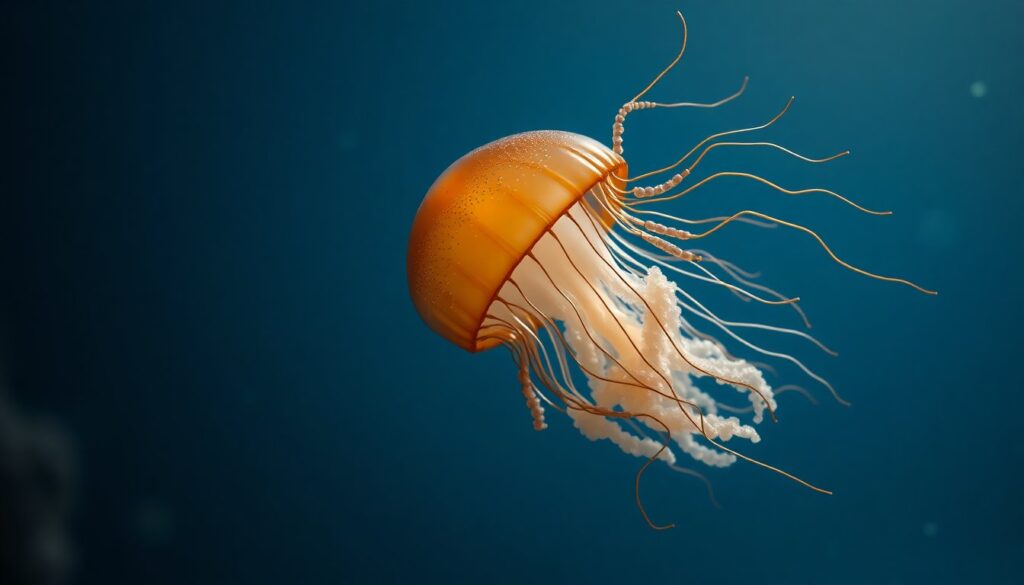
paleontology studies jellyfish cart stream feedback bmdinouiplasd offers a new way to link modern observations to fossil traces. The phrase names a workflow and a dataset. The workflow tracks how jellyfish move, shed tissue, and leave impressions. The dataset records measurements from field sensors and lab tanks. This guide explains how researchers use that input to read soft‑bodied fossils and test hypotheses about ancient ecosystems.
Key Takeaways
- The paleontology studies jellyfish cart stream feedback bmdinouiplasd workflow links modern jellyfish behavior to fossil evidence by analyzing movement, tissue shedding, and sediment marks.
- The Bmdinouiplasd dataset collects standardized flow, particle, and organic marker data to help identify soft-bodied jellyfish fossils in sediment layers.
- Researchers use a multi-step method combining live observations, controlled flow experiments, sediment core analysis, quantitative modeling, and field validation to interpret ancient soft-bodied fossils.
- The workflow improves fossil site interpretations by distinguishing biological marks from sediment patterns and informs targeted sampling of low-energy depositional environments.
- Future expansions of the dataset and machine learning tools will enhance identification accuracy and broaden environmental and taxonomic coverage in soft-bodied fossil studies.
Why Jellyfish Matter To Paleontology: Soft‑Bodied Fossils And Ecosystem Signals
Jellyfish leave weak hard parts. They lack bones and shells. They deposit soft tissue that decays fast. Yet jellyfish can leave sedimentary marks and chemical signals. Paleontologists study those marks to identify soft‑bodied fossils. The team records size, motion patterns, and decay products. They compare modern jellyfish traces to fossil beds. The process links living behavior to preserved traces.
Jellyfish also shape ecosystems. They eat small plankton and release organic matter. That matter changes local oxygen and mineral conditions. Those changes affect how soft tissues fossilize. When researchers study modern jellyfish, they map where preservation improves or fails. This mapping helps them interpret ambiguous fossil features. The mapping also helps narrow which ancient layers might contain soft‑bodied remains.
The phrase paleontology studies jellyfish cart stream feedback bmdinouiplasd appears across recent reports. Teams use the phrase to label experiments that couple flow tanks, field cameras, and chemical sensors. That coupling makes it easier to test which signals mean true biological remains and which signals mean random sediment movement.
What Cart Stream Feedback Is And How The Bmdinouiplasd Dataset Fits In
Cart stream feedback describes a loop of observation, modeling, and validation. Teams place jellyfish or analogs in flow channels and record how tissue detaches and moves. They model particle transport and then compare models to sediment cores. The loop refines predictions about imprint shapes and chemistry.
The Bmdinouiplasd dataset collects standardized records. The dataset logs flow speed, particle size, organic marker levels, and image sequences. Researchers archive those values with timestamps and location tags. They use the dataset to train classifiers that flag possible soft‑bodied fossils in core samples. The dataset name mirrors project shorthand: paleontology studies jellyfish cart stream feedback bmdinouiplasd. Teams cite it in methods and in public repositories.
The dataset aims for repeatable tests. It includes controlled lab trials and aligned field observations. That mix lets researchers test a model in a tank and then seek the same pattern in a rock layer. The dataset contents let a team state whether a pattern likely came from a jellyfish or from abiotic sediment flow.
Origins, Structure, And Limitations Of The Bmdinouiplasd Data
Researchers began the dataset after observing puzzling soft impressions in Cambrian and Ordovician sites. They designed simple experiments. They placed living gelatinous animals or proxy gels in flumes. They recorded stream velocity, particle settling rates, and decay markers. They added high‑resolution photographs and chemical assays.
The dataset structure uses tables and time series. Each run includes metadata: species or proxy, temperature, salinity, and sediment type. The core fields are image frames, particle counts, and organic marker concentrations. The dataset also includes processed features for machine learning tasks.
The dataset has limits. It focuses on shallow, low‑energy flows. It samples a few taxa and proxies. It may not cover extreme conditions like deep currents or strong storms. The dataset also reflects modern ocean chemistry, which differs from ancient conditions. Researchers note these limits in their papers. They use the dataset as a starting point for targeted field validation rather than as a final proof.
Methods For Studying Jellyfish: From Modern Analogues To Fossil Traces
Teams use a layered method. First, they observe living animals. They measure umbrella motion, pulsation frequency, and tissue shedding. They record how fragments behave in flowing water. Second, they run controlled flume experiments. They vary flow speed and sediment grain size. They document the resulting imprints and chemical changes.
Third, they analyze sediment cores and bedding planes. They image layers with macro photography and scanning. They target layers with fine sediment where soft impressions survive. They test for organic markers known from the dataset. Fourth, they apply quantitative models. The models predict imprint shape and chemical signal strength for given flow and decay rates.
Finally, they validate predictions with field checks. They revisit sites and collect new samples. They calibrate models if the field results differ. The process uses the paleontology studies jellyfish cart stream feedback bmdinouiplasd dataset as a reference. The dataset lets researchers convert raw observations into testable markers for fossil detection.
Practical Implications: Reinterpreting Fossil Sites And Designing Future Studies
The workflow changes how teams read certain fossil beds. Researchers reexamine diffuse impressions and chemical anomalies. They test if a pattern matches jellyfish flow signatures in the paleontology studies jellyfish cart stream feedback bmdinouiplasd dataset. If a match exists, they assign a higher probability to a biological origin.
The approach also guides field sampling. Teams target fine‑grained layers near inferred low‑energy depositional settings. They collect paired chemical and image data. They include flow proxies in sediment logs to aid comparison with the dataset. This more focused sampling improves the chance to detect soft‑bodied remains.
Future studies will expand taxon coverage and environmental range. Teams will add deeper currents, higher salinity extremes, and more decay conditions to the paleontology studies jellyfish cart stream feedback bmdinouiplasd records. They will also refine machine learning classifiers. Those classifiers will scan large image archives and flag candidate fossils for expert review. The combined method will make it easier to spot genuine soft‑bodied fossils and reduce false positives tied to nonbiological sediment features.
Researchers expect steady improvements as more groups contribute runs and field checks. The dataset name, paleontology studies jellyfish cart stream feedback bmdinouiplasd, will remain a shorthand for the method and for the shared archive that supports these studies.