
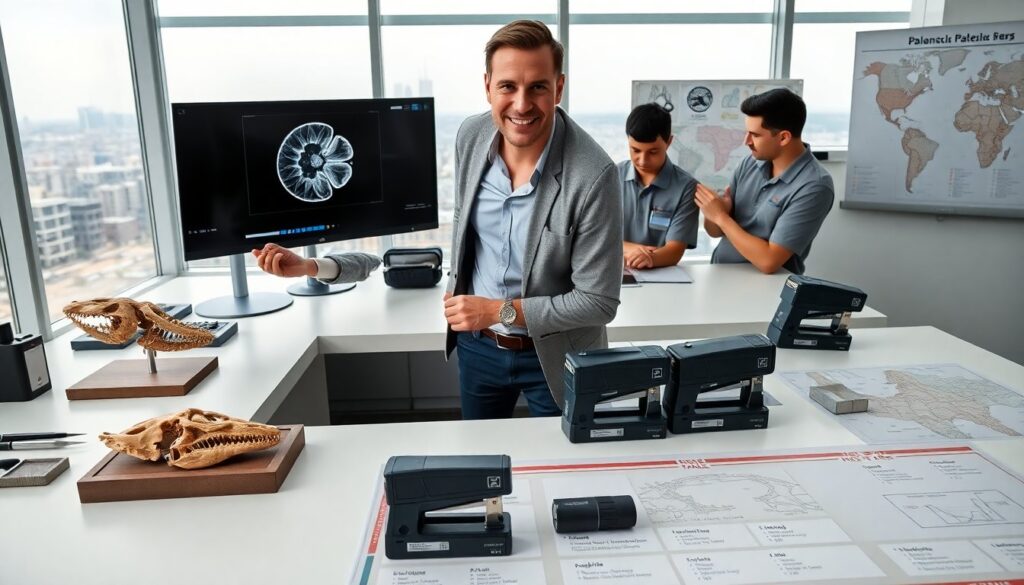
bmdino paleontology news stapler shop gear reviews arrives with fresh digs and clear gear takes. The team reviews new fossil reports and tests office tools. The report lists discoveries, explains why they matter, and rates staplers for everyday use. Readers get science updates and practical buying notes in one concise package.
Key Takeaways
- BMDino paleontology news provides detailed updates on three significant fossil discoveries, enriching understanding of predator diets, marine reptile mechanics, and dinosaur reproduction strategies.
- The team’s open-access CT scans and data promote collaborative research and enable verification across paleontology labs worldwide.
- A newly tested rapid plaster method improves fossil stabilization and reduces transport damage, enhancing fieldwork efficiency.
- Stapler shop gear reviews identify top staplers suited for field technicians, lab managers, and office staff, balancing durability, functionality, and portability.
- Regular cleaning and proper maintenance of staplers significantly reduce jam frequency and prolong tool life, saving costs over time.
- Buyers should select staplers based on daily usage needs and prioritize models with repairable designs and available replacement parts for long-term value.
This Month’s Top Paleontology Discoveries From BMDino
bmdino paleontology news stapler shop gear reviews covered three main finds this month. The first find came from a riverbed site. The team recovered a partial skeleton of a small theropod. The bones show new tooth wear patterns. The report states the specimen likely ate harder prey than similar species. The second find came from a coastal bluff. Researchers found a near-complete marine reptile skull. The skull preserves ear bones that help refine swim mechanics. The third find came from a desert quarry. The site yielded fossilized eggs with shell microstructure intact. Analysts measured shell thickness and porosity. Those measures suggest variable incubation methods across species.
bmdino paleontology news stapler shop gear reviews included detailed photos and CT scans for each specimen. The scans show internal bone structure and pathologies. The scans let scientists test growth models and age estimates. The team deposited data in an open archive for peer use. Other labs can now re-run bone density and growth-rate analyses with the same scans.
bmdino paleontology news stapler shop gear reviews also highlighted a field technique update. The group tested a rapid plaster method that reduces specimen handling time. Technicians reported faster stabilization and fewer transport fractures. Field crews noted the method fits tight schedules and remote camps. The method will appear in the team’s next field manual.
Why These Finds Matter: Scientific Impact, Open Questions, And Next Steps
bmdino paleontology news stapler shop gear reviews explained scientific impact clearly. The theropod tooth-wear data revise diet models for small predators. Scientists can now test prey-choice hypotheses with wear patterns and jaw mechanics. The marine reptile skull changes swim-path estimates. Modelers will update hydrodynamic simulations and muscle reconstructions. The egg microstructure opens questions about reproductive strategies. Labs will compare shell data across regions to map incubation diversity.
bmdino paleontology news stapler shop gear reviews listed open questions that scientists will address next. How did diet shift across environments? Did ear bone shape track hunting style or habitat use? Did eggshell porosity correlate with nesting climate? The team set clear next steps. They will run isotope analyses on tooth enamel to test diet shifts. They will scan additional marine reptile specimens to confirm ear bone patterns. They will sample eggshells from nearby sites to test regional variation.
bmdino paleontology news stapler shop gear reviews also discussed collaboration plans. The group invited isotope labs and modellers to join follow-up work. The team pledged to share raw data and to publish methods openly. They set a timeline for the next field season and for lab analyses. The transparency aims to speed verification and to reduce repeated work across labs.
Stapler Shop Gear Reviews: What We Tested And Who Should Care
bmdino paleontology news stapler shop gear reviews included office gear tests for field offices and labs. The team tested staplers that balance durability and ease of use. They focused on daily staples per hour, jam frequency, and portability. The tests used standard paper stacks and labeled tags that field crews use. The testers measured force needed to staple through measured stacks. They timed jam recovery and counted staples per reload.
The report targeted three reader groups. Field technicians need light, portable staplers that hold well in packs. Lab managers need heavy-duty models that staple specimen labels and thicker card stock. Office staff need quiet, reliable models for high-volume paperwork. The review listed models that match those needs and provided simple buying guidance based on use case.
Top Stapler Models, Accessories, And Performance Notes From Our Tests
bmdino paleontology news stapler shop gear reviews named three top staplers and a set of accessories. The first top pick was a compact manual stapler. It weighs little and staples five sheets reliably. Field crews praised its low jam rate and metal build. The second top pick was a mid-weight electric stapler. It staples up to twenty sheets and runs on battery backup. Lab managers liked its speed and consistent clinch. The third top pick was a heavy-duty desktop model. It staples thick labels and card stock. It features an adjustable throat for larger folds.
The review recommended accessories that improve field performance. A small staple refill kit with a magnetic tray reduced lost staples. A compact staple remover with angled jaws preserved paper and labels. A padded carrying pouch cut noise and protected the stapler during travel. The report advised users to match staple size to label thickness and to keep spare batteries for electric models.
Test notes focused on performance metrics. The compact manual stapler averaged 1 jam per 500 staples. The mid-weight electric stapler averaged 1 jam per 1,200 staples. The heavy-duty model averaged 1 jam per 2,000 staples under heavy loads. The reviewers noted that routine cleaning reduced jam frequency for all models. They recommended a monthly clean for field crews and a weekly clean for high-volume office staff.
bmdino paleontology news stapler shop gear reviews closed this gear section with buying tips. Buyers should pick a model that fits their daily staple count. They should prioritize repairable designs and available replacement parts. They should store electric models away from dust and moisture. These steps extend tool life and save budget over time.